Deviation Oil / Inspection Interval

ufods

War schon mal da
I just came back from my first inspection with simultaneous oil change / Leon VZ FL 2025

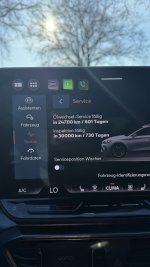
The onboard menu now shows:
Next oil change in 24,700 km / 601 days

Next inspection in 30,000 km / 730 days.

Dynamic oil change one way or another. The period should be identical, right?

Oil change and inspection should both be at 30,000 km / 2 years, especially since it has just been reset.

Or is something different stored for my EU car from Denmark?

Thanks!
 

Attachments

  • IMG_8979.jpeg
    IMG_8979.jpeg
    2.2 MB · Views: 31
Ölwechsel ist dynamisch. Ändert sich sowieso nochmal.

Angenommen laut BC steht dein Ölwechsel an aber Inspektion erst 50 Tage später. Was spricht dagegen trotzdem beides zusammen zu machen?
 
Natürlich ist das Intervall dynamisch.
Aber sollte es nicht:
a) bei Beginn genullt sein
b) bei Inspektion und Öl die selbe Dauer stehen?
 
Also is bleibt ungeklärt. Der Händler sagt es sei, weil ich den Ölservice / inspektion vorgzogen habe. Aber ehrlich: wenn man zurücksetzt sollte dass anders aussehne.

Ich hab aber auch keine Erklärung, warum es 25.000km und 1 Jahr und 7 Monate ist.
 
Cupra Leon 2.0 TDI , BJ 06-2025
Habe auch ein ähnliches Problem. Fahrzeug mit 25000 km gekauft. Neuer Service incl Ölwechsel beim Vertragshändler. Bei Abholung Anzeige Service in 725 Tagen und 30000 km. Ebenso beim Ölwechsel Anzeige 725 Tage oder 30000 km. Jetzt, 22 Tage und 1400 gefahrene Kilometer später, folgende Anzeige: Service in 703 Tagen und 28600 km. Beim Ölwechsel, Ölwechsel in 16000 KM oder 394 Tagen . Fahrprofil ist Arbeitsweg einfach 70 km mit 25 Km Landstraße und 45 Km Autobahn. Also eigentlich ideal für einen Diesel. Ich denke, da kann was nicht stimmen. Was meint ihr, hat jemand Fachwissen?
Grüße Mario
 
Hatte ein Kollege auch und hat nachgefragt: Im Öl ist ein Sensor der die Viskosität misst. Viel Stadtfahrten verkürzen den Intervall zum nächsten Ölwechsel. Ich hab 8k KM mehr drauf und er war bereits bei dem Ölservice. Ich fahre viel AB und er fährt eigentlich nur in und um Köln.
 
Na ja, ich habe bei einem eigentlich idealen Fahrprofil nach 1400 gefahrenen Kilometern 14000 km vom maximalen Ölwechselintervall (30000 auf 16000) verloren. Das erscheint mir nicht logisch. Wenn ich das hochrechne muss ich nach 3000 gefahrenen Kilometern wieder zum Ölwechsel, das kann nicht sein
 
Deine Beobachtung ist richtig und ist technisch erklärbar.

Der Grund ist ein dynamischer Berechnungsalgorithmus, der sein Ergebnis laufend anpasst.

Wie funktioniert das System?

CUPRA (wie alle VAG-Fahrzeuge) nutzt eine sogenannte Flexible Serviceintervall-Anzeige. Diese berechnet den nächsten Ölwechsel nicht starr nach Kilometern, sondern individuell anhand deines Fahrverhaltens. Der Bordcomputer wertet dafür kontinuierlich aus:

- Anzahl der Kaltstarts
- Kurzstreckenanteile
- Volllastfahrten
- Gesamtbetriebsstunden
- usw.

Aus diesen Werten schätzt das System, wie stark das Öl beansprucht wird, und berechnet den nächsten fälligen Wechsel. Der Rahmen dabei: mindestens 15.000 km / 12 Monate, maximal 30.000 km / 24 Monate.

Warum ist der Zähler nach nur 1.400 km so stark gefallen?
Ganz einfach: Das System kennt dein Fahrprofil zu diesem Zeitpunkt noch kaum. Es hat nur wenige Datenpunkte und rechnet daher zunächst konservativ – also auf der sicheren Seite. Es projiziert die bisher gefahrene Strecke pro Monat auf die gesamte verbleibende Laufzeit und kommt so zu einem niedrigen Anfangswert.
Mit zunehmender Fahrleistung lernt das System dein Profil besser kennen. Da du täglich 70 km fährst – überwiegend Landstraße und Autobahn – sind das optimale Bedingungen für einen Diesel: der Motor wird warm, das Öl wird nicht übermäßig belastet. Der angezeigte Wert von ca. 16.000 km bis zum nächsten Ölwechsel ist für dieses Fahrprofil durchaus plausibel und im normalen Bereich.
 
Guten Morgen!
Kann mir jemand bitte sagen, wann man das erste Mal einen Ölwechsel bzw. Inspektion gemacht werden muss. Ich habe das Auto vor einen Jahr als Neuwagen bekommen. Da es mein erstes eigenes Auto ist habe ich leider noch gar keine Ahnung.
 
Du kannst dir das auch im Auto anzeigen lassen, Cupra sagt hier, ab 30.000 km oder nach ich glaube 3 Jahren.
Du kannst es dir auch in der App unter Fahrzeug Status anzeigen lassen.

LG
 
Kann mir jemand bitte sagen, wann man das erste Mal einen Ölwechsel bzw. Inspektion gemacht werden muss.
"Müssen" tust Du es tatsächlich gar nicht. 😅

Sollte Dir allerdings daran gelegen sein, die Garantie des Fahrzeuges zu erhalten - solltest Du den Anweisungen im Display folgen.
In der App kannst Du ebenfalls nachschauen. Dort wird anhand Deines Fahrprofils der Verschleiß ermittelt und angegeben wann es ratsam wäre einen Ölwechsel/eine Inspektion durchführen zu lassen. (bei hinterlegtem Werkstatt-Favoriten gleich mit Online-Terminvereinbarung)

Ich selbst bin Fan des alljährlichen Ölwechsels, da ist mein Fahrzeug also etwas außerhalb des Rhythmuses - das muss aber Jede*r selbst für sich, den Wagen und den eigenen Geldbeutel entscheiden.
 
@Cupra2025 "In the oil, there is a sensor that measures the viscosity," in that case, one is practically forced to pour in 0W30 :-(
 
In that case, you are practically forced to pour in 0W30

not necessarily (only 0W30). The owner's Manual* should describe which VW standard the engine oil must meet (to remain under warranty). Often, the owner's Manual* even specifies two VW standards. Each of the standards can include one or two viscosities. Theoretically, therefore, even four viscosities could be conceivable.

The whole thing is a bit tricky; I also needed some phone calls with the :) for clarification. In case of doubt, I would recommend asking the :) with the VIN which VW standard the engine oil for the corresponding vehicle should meet.

What the colleagues above describe are the "individual and complicating" operating conditions that can shorten the MAXIMUM intervals for the oil change (for the ROC, it is a maximum of 30k km or 2 years, or the first inspection after a maximum of 30k km or 2 years, and all subsequent inspections after a maximum of 30k km or 1 year).

p.s.: @Käthe Your driving profile (70 km one way LS and motorway) is, in my opinion, not "difficult". Therefore, a theoretical question (just to rule out the case): You are already talking about the oil change and not about "checking the oil level" and topping up? Years ago, there were TSIs that lost engine oil. There was a TPI for that.
 
Last edited:
For the 333PS DNFF, only 50400 - 0W30 is approved. (From the official maintenance guide)

For some of the other engines, 50800 - 0W20 is also approved. (However, it's either/or - no engine has both approvals)
 
I received the following response from a "true" oil expert: The additives in 0W30 and 5W30 are +/- the same. The only "big" difference lies at extreme low temperatures: from -30°C, the 5W30 becomes somewhat thicker. However, since the viscosity of the 5W30 is better at normal temperatures, I will confidently switch to 5W30 during the first complete oil change, regardless of what VW or, as in my engine's case, Audi specifies for the VZ5.
 
Let's go back to the sensor. I got a bit off-topic with the oil standards, sorry.

Is it possible that the sensor is specifically calibrated only for the viscosity range (elasticity range) of the approved engine oil? Otherwise, in my opinion, it wouldn't be possible to calculate an oil change interval for the respective vehicle because the sensor wouldn't be able to determine whether the oil is operating only at the lower end of the elasticity range (e.g., short trips in urban areas - low oil temperature - low viscosity) or across the entire range. That's how I understand #7.

(However, either/or - no engine has both approvals)

A small note on this: the 1.5 TSI T-Roc has two approvals VW 50400 and 50800, otherwise I wouldn't have mentioned it.
 
Last edited:
A small note on this: the 1.5 TSI T - ROC has two approvals VW 50400 and 50800, otherwise I wouldn't have written it.

For Cupra (regardless of model - 1.0 & 1.5 engines) only until model year 2020. With the note "The use of engine oil according to the specifications VW 504 00 instead of VW 508 00 may result in a deterioration of the vehicle's emissions values."

From model year 2021 onwards, only 50800 (petrol) or 50900 (diesel) for all engines.
 
Are you sure that this sensor even exists?
In my opinion, some software will calculate the oil condition, depending on driving behavior, load, short trips, number of cold starts, etc.
 
I’m starting to believe that too, because yesterday I had one line more than three days ago. Without the dipstick, you just have to rely on it, and if problems arise because of that, Cupra has to take responsibility.
 

* = Advertisement
Links marked with an asterisk (*) are affiliate links. If you click on one of these links and make a purchase, we receive a commission from the respective online shop or provider. This does not affect the price you pay.

cupra.forum · Alle Rechte vorbehalten · Dies ist kein Forum der Seat Cupra S.A.U.
Back
Top