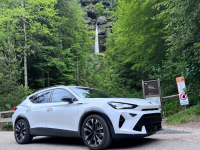
Formentor VZ Extreme Glacial White

Welcome! You have been invited by Tygulav to join our community. Please click here to register.
Currently traveling in Slovenia, mega beautiful country highly recommended.
Viršič Pass is really fun 😍

545C7321-F905-4F4C-80CC-EB842F6881FC.png

Almost 10,000 km on the clock, still no problems.
 
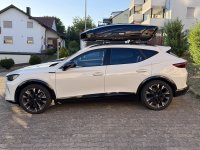
On Sunday, we're heading to Spain ☺️ That's why I already mounted the roof rack along with the roof box today. The roof rails were preemptively protected with paint protection film – better safe than sorry. 😄

Thule Wingbar Edge with a Thule XT Motion L.

IMG_3762.jpeg
 
Last edited:
IMG_3869.jpeg
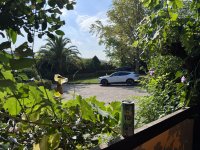
The Vichy Catalan must not be missing, of course 😋

Fuel consumption with the roof box was 10.7 liters over nearly 1300 km of driving. I drove at an average speed of about 130-135 km/h wherever possible.
 
Last edited:
Great view, I must say!👌

The phrasing "I drove at an average of about 130-135 km/h where possible" confused me the most...
It could also mean: 75% country roads, 15% city traffic, and then a maximum of 10% "130-135 km/h" is possible.

The questions arise:
What was the average speed?
and
How much less does it consume at the same speed without the roof box?
 
@Angefixt

Was of course only related to the holiday route, 90% motorway.

The average speed was 116 km/h.
No idea, if I hadn't had a roof box, I would have messed up the average in Germany on the motorway 😂
I find the Formentor with that engine anything but economical.

What is super annoying on such trips is the small tank. 75-80 liters would be great.
 
I think he means the speed on the motorway (and where one can drive). So, as already mentioned, "where it was possible," then not much faster than 135 km/h.
Effectively, it would have been more like a maximum of 100 km/h. Outside of Germany, 130 km/h is rarely possible, if at all.

On the overall route, the average speed regarding fuel consumption is also not really meaningful for a comparison. For example, there were certainly not a few uphill sections, and uphill, the fuel consumption is higher at the same speed. The steeper and slower it gets, the less the roof box plays a role. When you let it roll downhill, the roof box also has no influence on consumption, etc.

The actual additional consumption of the box can surely only be compared if you drive the route as similarly fast as possible once with and once without the box, with comparable total weight, under the same weather conditions, the same fuel, etc. On such a route, different factors already make a huge difference.
 
@dantheman 116 is already a very good average; you really made it through well. I can't even manage that on our autobahn when I drive 140 - 150 on the permitted stretches, because the proportion of permitted stretches is no more than 50%.

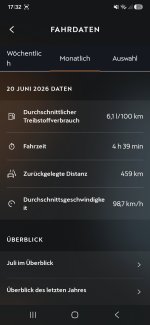
Here is an example of the route to the Baltic Sea this year twice (February and June), and always between 95 and 98 km/h and everywhere 7 - 15 km/h over the maximum speed.

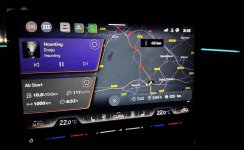
Screenshot_20260818_173259_My CUPRA.jpg
 
Last edited:
@ekm

I was really satisfied. I drove the entire night, no traffic, no incidents, and thanks to Telepass (vintrica) there were also no stops at the toll booths.

I even took a photo at 1000km because everything was going so well 😅

IMG_3912.jpeg
 
  • Like
Reactions: ekm
I think he means the speed on the autobahn (and where one can drive). So as already mentioned, "where it was possible," then not much faster than 135 km/h. Effectively, it would have been more like a maximum of 100 km/h. Outside of Germany, 130 km/h is rarely possible, if at all.

Regarding the overall distance, the average speed in relation to fuel consumption is also not really indicative for a comparison.
The average speed is definitely more meaningful than a statement like "where it was possible, I drove 130-135 km/h."

But perhaps you couldn't quite follow my example due to the percentage distribution of the distances (it would behave similarly with national speed limits). I wasn't aiming for an exact comparison under laboratory conditions, but rather to get a sense of a possible increase in consumption when using a roof box.
 
@Angefixt

I would say that the roof box adds at least 1 liter/100 km to fuel consumption, if not even a bit more.

I don't have a direct comparison, but when I was in Slovenia, I drove through Austria, where it was possible, at around 135 km/h. There, the consumption without the roof box was already at nearly 9.x l/100 km.
 

* = Advertisement
Links marked with an asterisk (*) are affiliate links. If you click on one of these links and make a purchase, we receive a commission from the respective online shop or provider. This does not affect the price you pay.

Back
Top